beating the unbeatable and managing its messiness
UNBEATABLE earned my ears early on with its debut in the 2021 [white label] demo. From the jump it wore its inspiration on its sleeves and those outfits might have come straight from my own wardrobe: an Imaishi art style plucked right from turn of the millenium Gainax; a noisy, shoegazy garage rock soundtrack; Xenogears, Devil May Cry, the works of Charlie Kaufman and Suda51 as sources of narrative and ludological design inspirations.
All of that is my shit! It would be a nigh insurmountable task to try and find a list of creative threads that are more in tune with my tastes than that. The indie-meets-introspective and perhaps a pinch pretentious blend is exactly what speaks to me-- and the demo was happy to talk. In my play of [white label], I saw those elements in action. It had a VHS-style haziness over low-poly environments, a really kicking soundtrack, and the lightest crumbs of a character-focused story. From that EP-length snippet, I was sold. The dev team had convinced me that they could deliver on the vision and style they had in mind. All that I had to do was wait until Tuesday last week, when the game finally dropped.
I came away from the game breathless, baffled, confused, a little bit disappointed, content. Untangling all that is still a work in progress.
The parts that first drew me to the game remain intact. The visual style is delightfully more of the same, sharp and edgy silhouettes billboarded against washed out environments. The soundtrack remains phenomenal in both the vocal and background tracks. The core rhythm gameplay still maintains a great balance of approachable but challenging and the arcade mode is a great way to play your fill of the soundtrack. It is the narrative elements that disappointingly seem the most dissonant.
UNBEATABLE wants to cover a lot of ground. It starts off as somewhat of a road trip story, then slams the brakes early on in a prison sequence, then turns a touch Yakuza-like in a small seaside town, then hard cuts to life in the big city as a leading voice (literally) of opposition against a fascistic police force who has made music illegal. It populates those settings with narrative threads about depression, interpersonal band drama, the ties between mental health and the creation of art, psuedo-metaphysical jargon right out of Evangelion, terminal illness, growing up. It is dense and loud and sometimes soft and has just so much it wants to say.
There are pieces of all that which really, really landed for me. Particularly, I thought the game really sung when it leaned more into a character study; episode 3, the aforementioned seaside scene, was a stand out for this reason. The four person group is kinda-sorta breaking up-- though they never formally signed up for anything. They're at a point where it is no longer enough to be musicians within a close vicinity of each other. What do they each want to get out of all of this? What's driving them to be creative? Why do they want to make music, and for whom? These questions are left to marinate as the player is given free reign to explore the small town. The story pace here is laconic; the main character, Beat, can spend time talking to some of the locals or working a part time bartending job while figuring herself out in the background. There is this pervasive air of aimlessness in both gameplay and narrative that I thought welded together very effectively.
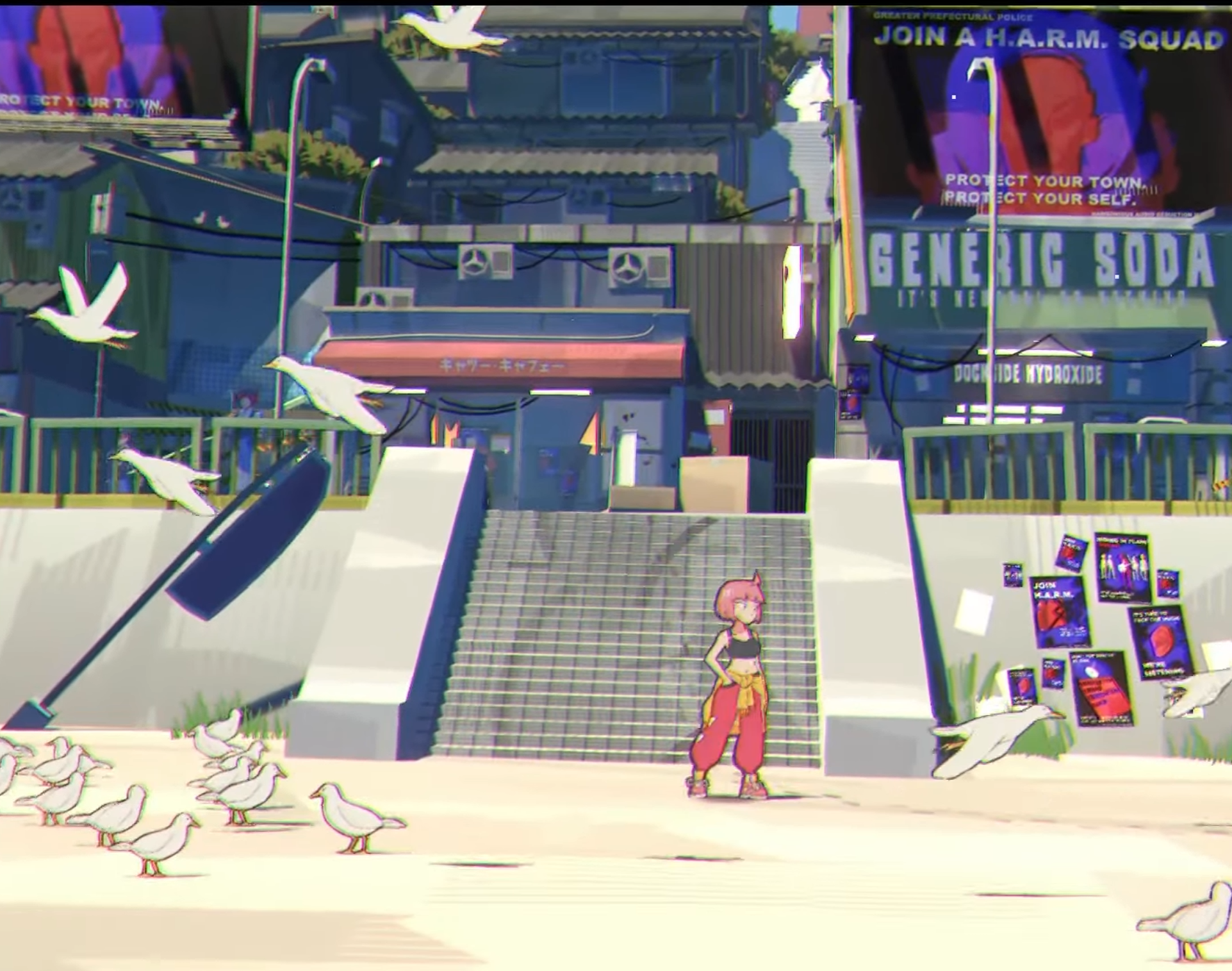
There's one moment during this segment that I found particularly profound. As Beat wanders around the town trying to figure out what to do about everyone and especially herself, she can choose to stand by the sea for a moment or two and listen to the sounds of the sea. Buoys bobbing in the bay chime their bells and seagulls squawk in the sky above. As the waves slowly roll in, the screen fills with static before chopping up the current scene into what appears to be pages of a notebook. As a short rhythm section begins, you see Beat sketch in and around these panels as the ambient sounds are layered with piano and a humming melody.
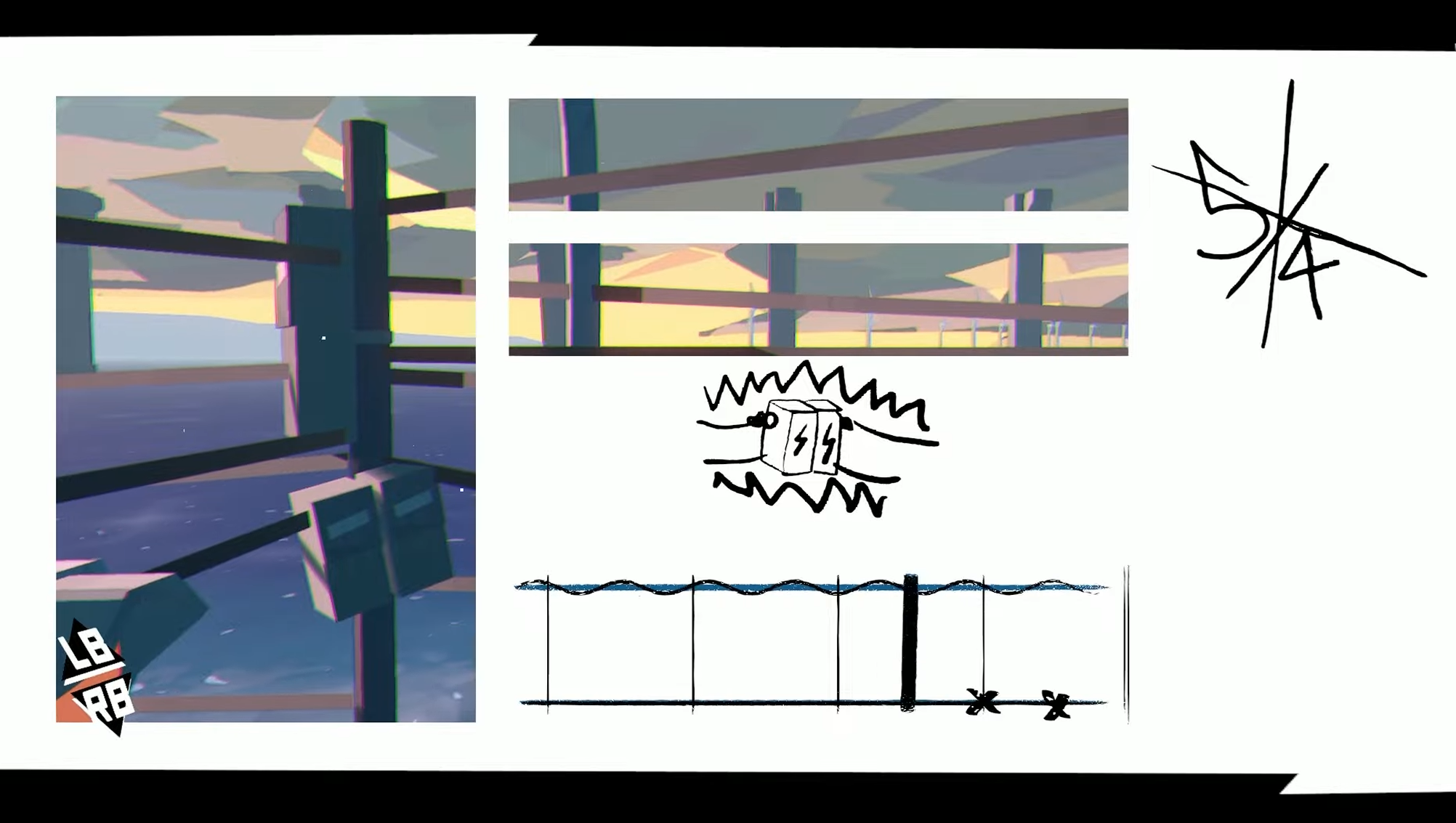
At this point, the narrative asks why an individual would engage in the act of creating art. We are told explicitly Beat's motivations for playing later on in the episode, but this scenes gives a wordless answer first: because the compulsion to create feeds on every mundane experience of living. Beat can be taken by inspiration anywhere at any time. She cannot separate living from making. Life is inspiration. This scene epitomized one of UNBEATABLE's strongest themes for me: how art is derived from the everyday, with music being the thread to sew them together. It is well worth watching this moment in motion.
Episode 3 is the most wholly cohesive part of the game. I felt it stuck to this theme of creative compulsion very effectively. But, again, that's just one part in the whole thematic composition of the game. How does UNBEATABLE handle the transition from a very character-centric and introspective arc to one focusing on terminal illness and a authoritarian police state, as episode 3 and 4 do? Unfortunately, it doesn't really. It opts for hard cuts between story beats, with each episode being mainly its own bundle of concepts it wants to talk about. There are some throughlines, but the inter-episode plots are mostly disconnected from their neighbors.
I like most of these other ideas. They're mostly all told well and done justice by their respective arc. There are some wrong notes-- Episode 5 out of the 6 is a bit of a stumble as they make the mistake of trying to explain a Gainax ending-- but the game sticks the landing. It's a messy path to get there-- not sloppy, not careless, but messy-- yet gets there nonetheless. The closing moments are exceptionally well done and the final segment resounds with such a powerful feeling of catharsis that I had to hold myself back from shouting.
Immediately after finishing UNBEATABLE, I was describing the experience of the game to a close contact. I said felt a bit like sitting next to a friend as they scream their heart out. You hear every inch of whats on their mind. A large part of that is probably relatable. Maybe you hear some things you wish you hadn't. But you get it. They needed to get all that out there, to put it out into the world.
I was tuned into a lot of what I played in UNBEATABLE. I didn't like everything I heard; it rambled a bit, spent time in places I wish it hadn't. But I get it.